In the startup world, early success often creates a powerful narrative. A product takes off. Users sign up quickly. Investors show interest. Funding follows.
From the outside, it looks like the hardest part is over.
Yet, many such startups struggle when it comes to scaling. Growth slows. Costs rise. Momentum fades. In some cases, the business quietly fizzles out.
What went wrong?
The answer often lies not in a single mistake, but in a set of underlying issues that only become visible at scale. When we look closely, these challenges fall into five clear patterns.
1. Early Traction ≠ Sustainable Demand
A strong start can be misleading.
Some startups gain traction because they are riding a temporary wave. For example, several EdTech platforms saw rapid adoption during the pandemic. However, as offline systems resumed, user engagement dropped sharply.
In other cases, the initial success comes from a niche audience, promotional incentives, or novelty. This creates the illusion of strong product-market fit.
The real test, however, is repeat usage and long-term relevance. If customers do not stay, growth becomes a constant uphill effort.
The underlying issue: Early traction is mistaken for durable demand.
2. Revenue Grows, but Profitability Does Not Follow
Scaling exposes the strength or weakness of the business model.
Many startups grow rapidly but struggle with weak unit economics. The cost of acquiring customers remains high, while the lifetime value of those customers stays low.
Pricing adds another layer to the problem. To enter the market quickly, startups often price their products aggressively. While this helps in acquiring users, it creates a long-term constraint. Customers get used to low prices. Any attempt to increase prices leads to resistance or churn.
In parallel, easy access to funding can mask these issues. Losses are tolerated in the early stages. However, when funding slows down, the business model is forced to stand on its own and often cannot.
The underlying issue: Growth is not supported by a financially sustainable model.
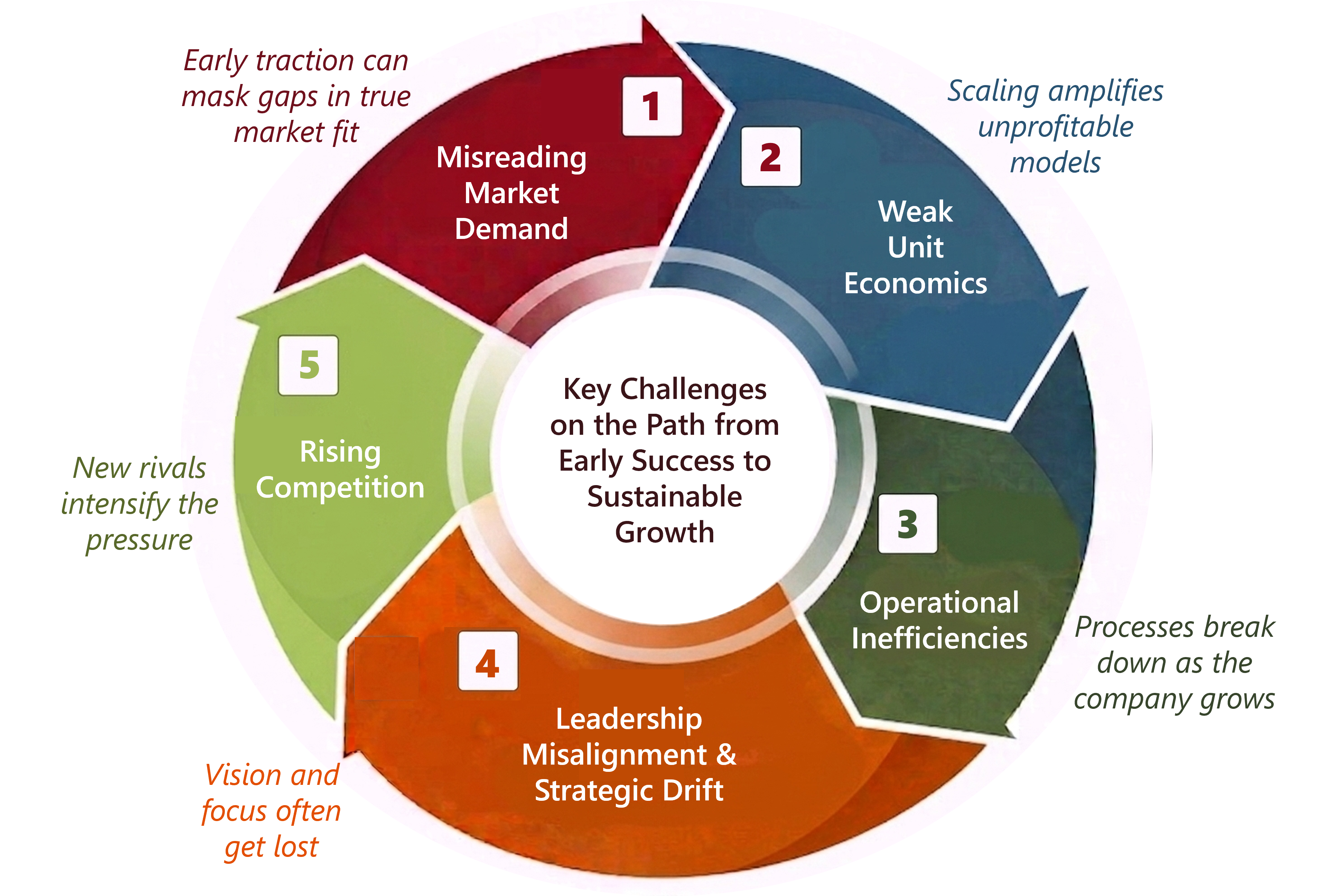
3. The System Does Not Scale with the Business
What works for a team of 10 rarely works for a team of 100.
In the early stages, startups operate with flexibility. Processes are informal. Decisions are quick. Teams are tightly aligned.
As the organisation grows, this approach begins to break down. Lack of structured processes leads to inefficiencies. Communication gaps widen. Decision-making slows down.
Hiring also becomes a challenge. Rapid expansion can lead to poor hiring decisions or cultural misalignment. Over time, this affects productivity and morale.
Without strong operational foundations, scale creates friction instead of efficiency.
The underlying issue: The organisation is not designed to handle complexity.
4. Growth Without Clarity Leads to Dilution
Scaling requires a shift in leadership.
Founders who excel at building a product may not always be equipped to manage a growing organisation. The skills required for early-stage innovation are different from those needed for structured growth.
At the same time, startups often lose focus as they expand. New features are added. New markets are explored. Multiple opportunities are pursued simultaneously.
While each decision may seem logical in isolation, the combined effect is dilution. The core value proposition becomes unclear.
In the absence of a strong strategic anchor, growth leads to dispersion rather than depth.
The underlying issue: The organisation outgrows its original direction and leadership approach.
5. What Was Once an Open Field Becomes a Battlefield
Early success attracts attention.
Competitors enter the space. Established players replicate the idea with better resources. Distribution advantages begin to matter more than innovation alone.
At the same time, external conditions evolve. Market demand may stabilise. Regulations may change. Customer expectations may rise.
Startups that thrived in a favourable environment now find themselves in a far more competitive and demanding landscape.
Adapting to this shift requires both resilience and strategic clarity.
The underlying issue: The external environment becomes less forgiving as the business grows.
The Real Challenge: Evolving Beyond Early Success
Across all these patterns, a common theme emerges.
Startups rarely fail because they cannot grow. They fail because they struggle to transition from early-stage momentum to scale-stage discipline.
Early success often depends on speed, timing, and opportunity. Scaling, however, depends on structure, consistency, and strategic clarity.
The capabilities that drive initial traction are not the same as those required for sustainable growth. When startups continue to rely on early-stage approaches, they begin to encounter friction.
The transition from one phase to the next is not automatic. It requires conscious effort. Founders and teams must reflect critically on whether their demand is truly durable, whether their pricing can support long-term value, whether their processes are ready for scale, and whether they are staying focused on what matters most. Equally important is an honest assessment of leadership readiness. Founders must ask whether they are best suited to lead the organisation through the scaling phase, or whether the business would benefit from bringing in experienced executives and empowering them to navigate the next stage of growth.
Those who recognise this shift and adapt accordingly are far more likely to convert early success into lasting impact.
Need Support in Scaling Your Startup?
If your organisation is experiencing rapid growth but facing challenges in sustaining or scaling it effectively, it may be time to take a step back and reassess your approach.
At Thulliyam Consulting, we work closely with organisations to strengthen operational processes, improve financial discipline, and build structures that support sustainable growth.
If these challenges resonate with your current situation, we would be glad to connect and explore how we can support your scaling journey.